For years, OAM Technology has used three fundamentals to explain how complex digital systems become understandable and manageable: Information, Interfaces, and Processes.
Those fundamentals still matter. In fact, they matter more in the AI era.
Generative AI, agentic workflows, MCP servers, autonomous operations, and AI-enabled architecture do not remove the need for disciplined system design. They increase it. AI agents can only operate effectively when they understand the information they are using, access systems through controlled interfaces, and execute work through observable, governed processes.
The AI Agentic Workflow Stack is a modern expression of that original architecture model.
The three fundamentals still define the architecture.
AI changes the implementation patterns, but it does not change the architectural questions. Every AI-enabled workflow still depends on three core concerns:
- Information: What does the agent know, retrieve, reason over, and remember?
- Interfaces: What systems, tools, APIs, and services can the agent safely access?
- Processes: What work can the agent coordinate, execute, escalate, and improve?
When these three areas are weak, AI pilots often remain impressive demos but fail to become production capabilities. When they are designed intentionally, AI becomes part of the operating fabric of the enterprise.
Information becomes the context layer.
In traditional enterprise architecture, information modeling focused on the structure, meaning, and governance of data across systems. In an agentic AI architecture, information expands into a broader context layer. Agents need access to trusted, relevant, and well-governed sources of knowledge.
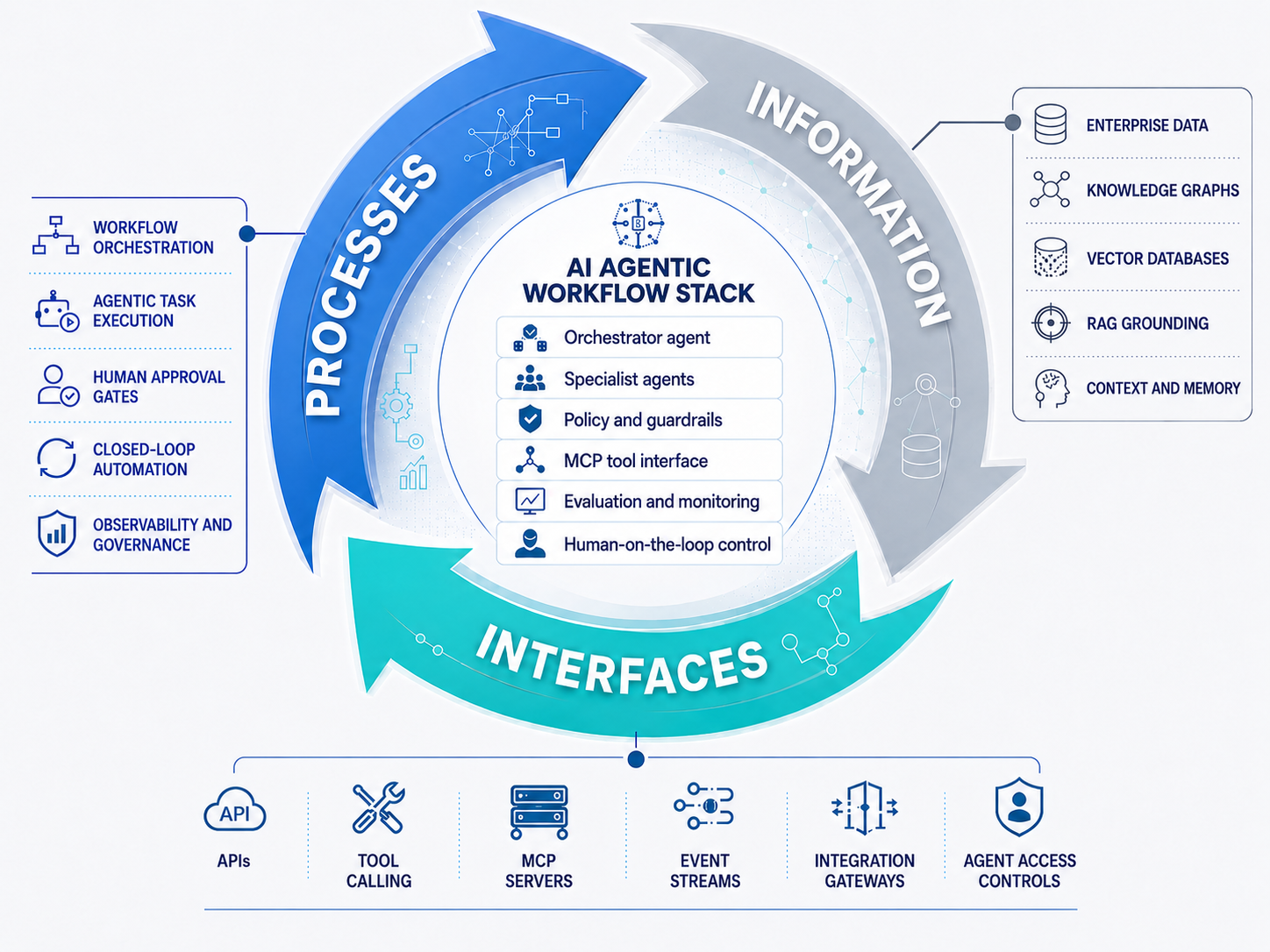
This includes enterprise data, knowledge graphs, vector databases, Retrieval-Augmented Generation (RAG) grounding, and context and memory.
This layer determines whether an agent can produce reliable, explainable, and context-aware outputs. Without it, the agent is forced to rely too heavily on the general knowledge of the foundation model, which increases the risk of hallucination, inconsistency, and weak operational fit.
For digital infrastructure providers, this context layer may include product catalogs, service inventory, network topology, trouble tickets, runbooks, telemetry, customer information, API specifications, application code repositories, test cases, test results, and architecture repositories.
Interfaces become the controlled tool layer.
Interfaces have always been central to OAM's architecture approach. APIs, integration patterns, event flows, and system boundaries determine how platforms work together. In the agentic AI era, interfaces take on a new role. They become the controlled tool layer that allows agents to interact with enterprise systems.
This includes APIs, tool calling, MCP servers, event streams, integration gateways, and agent access controls.
MCP servers provide a standardized way to expose tools, data sources, and enterprise capabilities to AI agents — a consistent interface pattern for controlled access, rather than ad hoc system interaction.
In this model, MCP servers sit within the Interfaces layer. They are not a replacement for APIs, integration architecture, or governance. They are a modern mechanism for making enterprise capabilities available to AI agents in a reusable and policy-aware way.
Processes become agentic workflows.
Processes define how work gets done. In legacy automation, processes were often expressed through BPMN models, workflow engines, scripts, service orchestration, and operational procedures. In the AI Agentic Workflow Stack, processes evolve into agentic workflows.
This includes workflow orchestration, agentic task execution, human approval gates, closed-loop automation, and observability and governance.
The shift is not simply from manual work to automation. The shift is from static automation to adaptive, context-aware workflows where agents can reason, retrieve information, call tools, coordinate tasks, and escalate decisions when human judgment is required.
This is especially important in network and service operations. AI agents may help triage incidents, correlate alarms, query inventory, summarize service impact, recommend remediation steps, generate change plans, or coordinate across operational systems. But these workflows must be observable, auditable, and bounded by governance.
The center of the stack: agent orchestration and governance.
At the center of the AI Agentic Workflow Stack is the agent operating model. The core capabilities include the orchestrator agent, specialist agents, policy and guardrails, the MCP tool interface, evaluation and monitoring, and human-on-the-loop control.
The orchestrator agent coordinates work across specialist agents and tools. Specialist agents may focus on troubleshooting, inventory, knowledge retrieval, integration, reporting, or operational analysis. Policies and guardrails define what agents are allowed to do. Evaluation and monitoring determine whether the system is performing safely and effectively.
Human-on-the-loop control is essential for high-impact enterprise and infrastructure workflows. The goal is not to remove human accountability. The goal is to reduce friction, accelerate analysis, improve consistency, and keep people focused on the decisions that require judgment.
Human-in-the-loop controls require direct human participation at defined workflow steps, such as approving a sensitive action or validating an agent recommendation. Human-on-the-loop controls allow agents to operate within established boundaries while people monitor outcomes, review exceptions, and retain the authority to intervene or override decisions.
Why this matters for digital infrastructure providers.
Digital infrastructure is becoming more complex at the same time AI workloads are changing traffic patterns, latency expectations, and operational requirements. Telecom, cable, fiber, data center, cloud, interconnection, satellite broadband, and digital service providers are all facing a similar architecture challenge:
- More bandwidth-intensive services
- More real-time inference workloads
- More automation pressure
- More distributed infrastructure
- More operational data
- More demand for low-latency, high-reliability services
Agentic AI can help, but only if it is built on a sound architecture foundation. The Information, Interfaces, and Processes model provides a practical way to organize that foundation. It connects legacy architecture discipline to the emerging AI stack without pretending that AI is a magic layer that can be placed on top of fragmented systems.
A practical architecture view.
The AI Agentic Workflow Stack can be read as a practical architecture model:
| Foundation | AI-era role | Example capabilities |
|---|---|---|
| Information | Context and knowledge layer | Enterprise data, knowledge graphs, vector stores, RAG grounding, memory |
| Interfaces | Controlled tool and integration layer | APIs, tool calling, MCP servers, event streams, gateways, access controls |
| Processes | Agentic workflow and operations layer | Orchestration, task execution, approvals, closed-loop automation, observability |
The value is not in any one technology. The value comes from designing the relationships between the layers.
From architecture fundamentals to AI execution.
Agentic AI succeeds when the enterprise has clarity about what agents can know, what they can access, what work they can perform, and where humans remain accountable. That is why Information, Interfaces, and Processes remain a useful architecture lens. They help organizations move beyond generic AI experimentation and toward production-grade AI workflows that are grounded, integrated, governed, and operationally useful.
For OAM Technology, this model represents continuity and evolution. The original architecture fundamentals still apply. The technology stack has changed. The need for disciplined architecture has not.